
Finding the right words can make writing more professional, natural, and interesting. One phrase that appears frequently in academic writing, blogs, business content, and everyday communication is “for example.” Although this phrase is simple and useful, repeating it too often can make your writing sound predictable. That is why learning a variety of for example synonyms can help you express the same idea in different and more engaging ways.
Whether you are writing an essay, blog post, report, presentation, or email, using alternatives to “for example” can improve the overall quality of your content. In this guide, we will explore common synonyms, explain when to use them, and provide practical examples.
What Does “For Example” Mean?
“For example” is used when you want to introduce a specific person, thing, situation, or idea that supports or explains a general statement.
For instance, if you say:
“Many fruits contain important vitamins. For example, oranges are rich in vitamin C.”
The phrase “for example” introduces oranges as a specific example of the broader statement about fruits.
The expression is common because it is clear and easy to understand. However, writers may sometimes want an alternative that sounds more formal, conversational, or concise.
Common For Example Synonyms
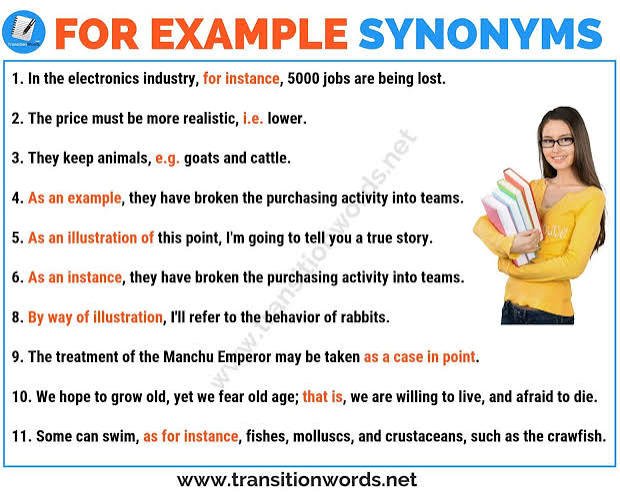
There are many alternatives to “for example.” The best choice depends on the type of writing and the sentence you are creating.
1. For Instance
“For instance” is one of the closest synonyms for “for example.” It has almost exactly the same meaning and can be used in most situations.
Example:
“Many people enjoy outdoor activities. For instance, hiking and cycling are popular choices.”
This phrase works well in essays, articles, reports, and general writing.
2. Such As
“Such as” is another useful alternative, especially when you want to list specific examples.
Example:
“Several programming languages, such as Python, Java, and JavaScript, are widely used.”
Unlike “for example,” “such as” is usually placed directly before the examples rather than at the beginning of a separate sentence.
3. Including
“Including” can be used when you want to mention some examples from a larger group.
Example:
“The store sells many electronic products, including headphones, keyboards, and speakers.”
This option is particularly useful for business content, product descriptions, and informational articles.
4. Namely
“Namely” is useful when you want to identify specific items or clarify exactly what you mean.
Example:
“The project requires three important skills, namely communication, organization, and teamwork.”
It sounds more formal than “for example,” so it can work particularly well in academic or professional writing.
5. To Illustrate
“To illustrate” is useful when introducing an example that helps explain an idea.
Example:
“Technology can make education more accessible. To illustrate, online courses allow students to learn from almost anywhere.”
This phrase is a strong choice for essays, reports, and explanatory articles.
6. As an Example
“As an example” is a direct alternative that clearly signals that the following information is an example.
Example:
“Many businesses use digital marketing. As an example, small companies can use social media to reach new customers.”
It is simple, natural, and easy for readers to understand.
7. By Way of Example
“By way of example” is a more formal expression. It can be useful in professional, legal, or academic contexts.
Example:
“Different strategies can improve productivity. By way of example, creating a daily schedule can help people manage their time.”
Because it sounds formal, it may not be the best choice for casual conversations.
Why Use Synonyms for “For Example”?
Using synonyms is not simply about replacing words. It can make your writing more varied and precise.
Avoid Repetition
If every paragraph uses “for example,” readers may notice the repetition. Alternatives such as “for instance,” “such as,” and “to illustrate” can make the text smoother.
Improve Your Vocabulary
Learning different expressions helps expand your vocabulary. This is particularly useful for students, bloggers, writers, and professionals who want their work to sound polished.
Match Different Writing Styles
Different situations require different language. “For instance” may sound natural in general writing, while “namely” may be better for formal content.
Make Ideas Easier to Understand
Examples help readers understand complicated ideas. Using appropriate phrases to introduce those examples creates a clear connection between the main idea and supporting information.
For Example Synonyms in Academic Writing
Academic writing often requires variety and precision. Instead of repeatedly using “for example,” students can use several alternatives depending on the sentence.
Example:
“Regular exercise can provide several benefits. For instance, it may support overall physical fitness.”
Another option is:
“Regular exercise can provide several benefits, such as improved endurance and increased physical activity.”
In a formal paper, “to illustrate” or “namely” may also be appropriate when the context requires a more formal tone.
However, writers should avoid using complicated expressions simply to sound intelligent. Clear and natural language is usually more effective.
For Example Synonyms in Business Writing
Business communication should be professional but easy to understand. Expressions such as “including,” “such as,” and “for instance” work particularly well.
Example:
“Our company provides several digital services, including website development, content creation, and search engine optimization.”
This sentence sounds professional without being unnecessarily complicated.
For Example Synonyms in Everyday Conversation
In casual communication, simple phrases are usually best. “For instance” and “such as” are natural alternatives.
Example:
“You can do many things during your free time, such as reading, walking, or playing a sport.”
In informal speech, you can also say “like” when giving examples.
Example:
“I enjoy outdoor activities like cycling and hiking.”
However, “like” is generally more conversational and may not be suitable for formal academic writing.
Choosing the Right Synonym
The best synonym depends on your sentence and audience. Here is a simple guide:
- For instance — general and versatile
- Such as — useful before a list of examples
- Including — useful for naming items within a larger group
- Namely — formal and specific
- To illustrate — useful when explaining an idea
- As an example — simple and direct
- By way of example — highly formal
- Like — casual and conversational
Remember that synonyms are not always interchangeable in every grammatical situation. Always check how the phrase fits into the sentence.
Final Thoughts
Using a for example synonym can make your writing more varied, professional, and engaging. While “for example” remains one of the clearest ways to introduce an example, alternatives such as “for instance,” “such as,” “including,” “namely,” and “to illustrate” can help you avoid unnecessary repetition.
The most important thing is to choose the expression that fits your sentence naturally. Good writing is not about using the most complicated words. Instead, it is about communicating ideas clearly and effectively.
By understanding different alternatives to “for example,” you can improve essays, blog posts, reports, business communication, and everyday writing while making your content more readable and polished.